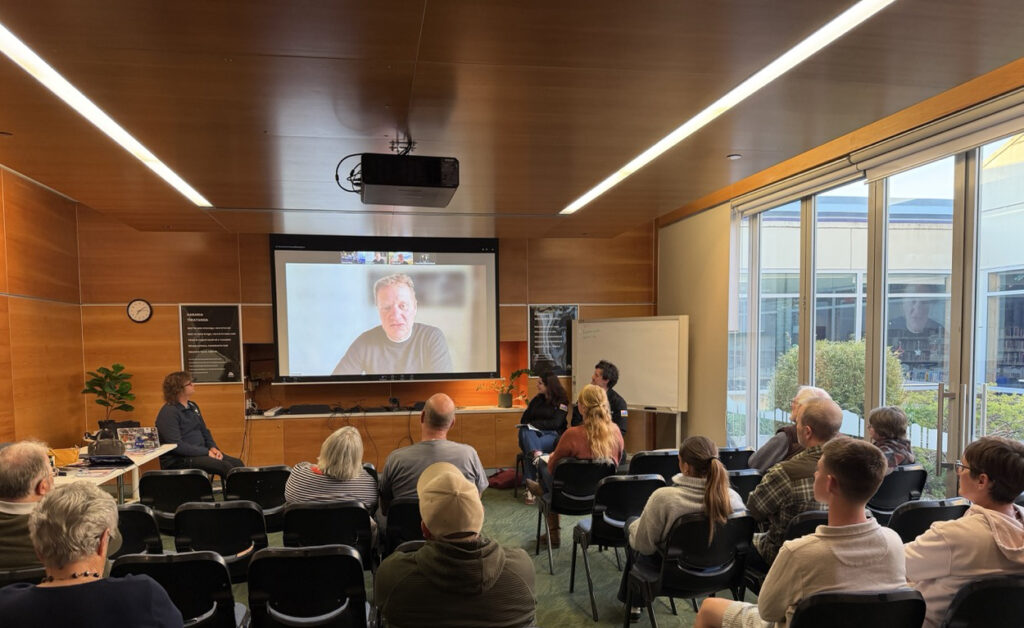

Fresh From Space, held during Carterton Space Week 2026, brought together Mark Rocket, astrophysicist Dr Yvette Perrott from Te Herenga Waka Victoria University of Wellington, Grace Andrews and TJ Ariu from the New Zealand Space Agency, with Sam Leske moderating the conversation.
The evening ranged from the experience of travelling to space to the future of New Zealand’s aerospace sector, radio astronomy, satellite data, environmental monitoring, space sustainability, human exploration of Mars, robotic exploration of the Solar System and, importantly, how young New Zealanders might find their own way into the sector. And somewhere along the way, a much bigger picture emerged.
New Zealand does space differently
Grace Andrews began with something she said she often encountered when she first joined the New Zealand Space Agency and was explaining what she does: “People didn’t even know we had a space agency.” We do. In fact, the agency celebrated its tenth anniversary this year, and New Zealand’s space story has developed rather differently from those of the traditional space powers.
As Grace explained, many countries began with enormous government space programmes around which private industries subsequently developed. New Zealand effectively did the reverse: a small country, a handful of people and companies with very large ideas, followed by the need to create the regulatory and policy framework around a rapidly emerging sector. Today, the New Zealand Space Agency works across regulation, policy and sector development. But perhaps the most important message of the evening was that the “space sector” is much bigger than the part that leaves Earth on top of a rocket. It includes manufacturing, navigation, telecommunications, Earth observation, environmental monitoring, emergency management, advanced aviation and an expanding collection of companies using information gathered from space.
Grace mentioned that one of New Zealand’s biggest areas of growth could be in downstream applications, companies taking satellite information and turning it into useful services here on Earth. That led to one of the most interesting ideas of the evening: New Zealand’s space sector and its primary industries increasingly meeting each other. Space technology helping agriculture. Satellite observations informing decisions on the ground. Data collected hundreds of kilometres above Earth becoming useful to farmers, environmental managers, councils and emergency services. Space, in other words, doesn’t necessarily look like space. Sometimes it just looks like better information about a paddock.
Space is getting crowded
There was another, less comfortable theme. From Wairarapa, inside an International Dark Sky Reserve, changes in the orbital environment are not abstract. We see satellites moving across our night sky, and a lot of them. The panel discussed the rapid growth of satellite constellations and the challenge of keeping space usable for future generations.
Grace put the apparent contradiction beautifully:
“Space seems infinite, but unfortunately there’s only so much of it in lower orbit.”
It is a strange thought because humanity has spent most of its history looking upward at an apparently limitless Universe. We are now reaching the point where some of the useful space immediately around our own planet has to be managed as a finite environment. That makes space sustainability not simply an engineering problem, but an environmental, regulatory and international one.
TJ Ariu spoke about the importance of maintaining a global community around space exploration and ensuring that space remains something that benefits everyone. For a place such as Wairarapa, where protecting the night sky is already part of the conversation, perhaps the next step is to think beyond protecting darkness on the ground. What responsibilities do we have for the environment above it?
What does space actually feel like?
Then there was the person on the panel who had actually been there. Mark Rocket travelled aboard Blue Origin’s New Shepard in 2025. His flight lasted only around ten minutes, but his description made clear just how much can fit into ten minutes. He described sitting on the rocket before launch as:
“Basically, you’re sitting on top of an explosion.”
Then came acceleration, engine shutdown and the sudden transition from being pressed into his seat to weightlessness.
Mark had promised himself he would do flips in zero gravity. For a few seconds, though, his brain apparently had other ideas and wanted to continue holding firmly onto the seat. Eventually, he let go. He described moving in weightlessness as surprisingly natural, rather like moving underwater without feeling the water. But the most powerful part of his account wasn’t the flips; it was looking out.
Seeing the blackness of space affected him deeply. He described an impression of darkness that simply continued, and said the experience gave him a new appreciation for the Apollo astronauts who travelled away from Earth into it using the technology available in the 1960s. Then gravity returned with enthusiasm. Within roughly a minute, Mark went from weightlessness to experiencing around five or six times Earth’s gravity during descent.
Do humans need to go everywhere?
An audience question then took the conversation farther out: what about human travel beyond the Moon? Yvette Perrott pointed to some of the formidable unsolved problems of sending people to Mars, particularly radiation exposure during the journey and on the Martian surface, and raised an interesting question: Just because humans can aspire to visit somewhere, does that mean sending humans is always the most interesting way to explore it?
For Yvette, robotic exploration of places such as Europa and Enceladus may offer much more scientifically compelling possibilities. Mark also argued strongly for robotic exploration, invoking New Zealander Sir William Pickering and the extraordinary legacy of robotic planetary exploration led by JPL. Humans or robots? It isn’t necessarily an either/or question. But it is a very good question about what exploration is for.
You do not have to be a rocket scientist
Perhaps our favourite part of the evening came from a question asked on behalf of a teenager in the audience:
What advice would the panel give a young person wanting to enter the space industry?
The answers should probably be pinned to the wall of every careers office in New Zealand. Engineering certainly matters. Mark talked about looking for people who don’t simply complete their coursework but build things, experiment and pursue side projects because they are genuinely interested. But engineering is only one door.
Grace’s own story illustrated that perfectly. Fascinated by space since childhood, she once thought her lack of enthusiasm for physics and mathematics meant abandoning that dream. University changed how she understood what a career in space could be. She found politics, law and policy. As she put it: “I sort of gave up for a little bit, but my dreams caught me in the end.”
Yvette described students combining space science with physics, biology and other disciplines, and even mentioned a student combining space with fashion design. It sounds unexpected until someone has to design a spacesuit. Space missions need engineers, certainly. They also need scientists, designers, lawyers, communicators, project managers, policy specialists, software developers, biologists, marketers, supply-chain specialists and people capable of convincing somebody to fund the whole thing.
TJ’s advice distilled much of the evening into one idea:
“Find the thing that you’re really curious about and follow your curiosity.”
And that’s definitely the bit worth remembering.
What comes next?
Grace said something else that stayed with us. Asked where New Zealand’s space sector might grow over the next decade, after discussing satellite data, advanced aviation and new companies, she suggested that some of the most interesting developments may be things we haven’t predicted at all. We don’t know what we don’t know. Ten years ago, much of New Zealand’s present-day space sector would have seemed improbable.
What might exist ten years from now? And could one of those ideas come from Carterton? Someone in the audience eventually asked the inevitable question: When are we going to have a rocket club here in Wairarapa? Well. Now there’s an idea.
_______________
Fresh From Space was part of Carterton Space Week 2026, bringing space science, exploration, technology and the people working in New Zealand’s growing space sector into the heart of Wairarapa.